(Contributing author: Ken Smith, INCA)
Pools and wetlands are amongst the most valuable and vulnerable of wildlife habitats. They are also one of the habitats which show the fastest results after they have been created. Within 12 months of pond creation, colonies of aquatic plants and animals can be thriving and within two years of creation, man made wetlands can look very natural and appear well established.
POND LOCATION
An area of low lying and naturally waterlogged land is obviously a good site for establishing a pond and wetland. It must be understood that a pond will only remain completely full if it is excavated below the natural water table of the area. Thus many artificial ponds will need to be lined with an impervious membrane and may need to be topped up with water during dry periods. Thus the source and cost of summer water supply and design of the pipework installation needs to be considered when planning a perched (above the water table) pond. If the subsoil at the site is impervious clay, then a pool can be made merely by excavating to the desired shape and depth. If the ground is porous and well drained, the pond and wetland area will need to be lined with some form of artificial membrane or clay imported onto the site and puddled into the excavated pond.
Sunlight plays an important role in the development of the flora and fauna of a pond. A pond situated in the shade will not be as productive as one that gets adequate sunlight and may also become stagnant.
A few overhanging trees can look attractive around large wetlands and lakes, but this should not be overdone and is best avoided completely in the case of smaller ponds. Trees not only shade the water, but leaves falling into the pond can result in deoxygenation of the water. However, trees such as willow, alder and aspen are important features of wetland sites and form good windbreaks, especially on the northern side of a pond. Trees should not be planted within 20 metres of a lined pond as their roots can eventually damage the pond liner.
POND DESIGN
Different plants and animals have different ecological requirements, so it is important that the main purpose of the pond and wetland is defined at the planning stage so that it can be designed accordingly. For example a habitat for water birds has different structural requirements to a pond intended for visits by young children. There are a number of basic principles that apply to most situations.
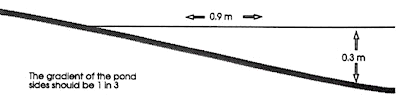
Larger ponds are generally ecologically better than smaller ones and irregular shapes are much more pleasing than formal geometric shapes. Gradually sloping shorelines leading into deeper water of approximately one metre are usually much better for wildlife than abrupt steep edges. High banks should only be used on larger ponds and lakes where special habitats such as nesting sites for sand martins or kingfishers are required. Even in such ponds, a significant area of bank should be constructed with a shallow slope to the water to allow egress by amphibians and small mammals such as hedgehogs.
POND CONSTRUCTION
 |
|
 |

POND LINING
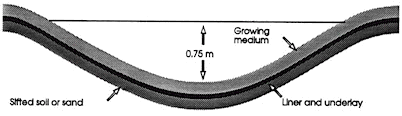
If a pond is excavated above the summer water table, in most cases it will need an impervious lining to prevent the water leaking away in the summer. The main exception to this principle is if the pond has been excavated in an impervious clay subsoil.
If an impervious clay (i.e. not a calcareous clay or marl) can be obtained cheaply, the pond can be excavated 500mm deeper than its intended water depth and lined with 500mm of clay, which is then heavily compacted by wheeled vehicles, then thoroughly wetted and further compacted (puddled). It should not be allowed to dry out between puddling and filling the pond or wetland.
More usually, an artificial impervious membrane of bentonite, plastic or butyl rubber is used as a liner. Manufactured bentonite linings are very easy to install and can be relatively resistant to deliberate vandalism. They are less resistant to perforation by plant roots, thus tend to leak a few years after installation. However, installation is simple, they are simply rolled out like a carpet, joins are overlapped and weighted with stones or soil, and the pond filled.
Various heavy-gauge plastic sheets are available for pond lining. The very thick gauges can be difficult to handle and to join on uneven contours. Thinner sheets are relatively cheap but can be easily pierced by stones and plant roots.
Butyl liners are flexible, relatively resistant to perforation, easy to join but relatively heavy to handle and more expensive than thinner plastic liners.
In general the installation of plastic or butyl liners is similar, a procedure for which is described in the Pond Liner Installation Guide.
AQUATIC PLANTS
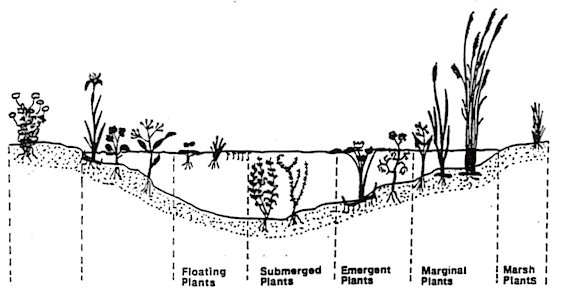
Water plants can be divided into five main types:
1 Marsh plants that live in waterlogged conditions of wetland habitats.
2 Marginal plants living in the shallow edges of pools. These provide cover for nesting birds and aquatic invertebrates as well as stems for insects such as dragonflies to climb when emerging from the water.
3 Emergent plants such as water lilies are rooted in deeper water but leaves and flowers protrude above the surface. Water lilies can help reduce the development of "green water" due to excessive algae growth resulting from over enrichment with nutrients. The large leaves of lilies shade some of the water and control the growth of algae.
4 Submerged plants live under the surface of the pond and provide food and cover for aquatic animals, also releasing oxygen into the water. Underwater weed beds should not normally be allowed to become so dense that they choke the pond, since excessive weed growth reduces water movement and gas exchange.
5 Floating plants are not anchored by roots, feeding directly from the nutrients in the water. They should not be permitted to cover a significant area of a pond surface or they will shade the submersed plants and drastically reduce gas exchange at the water surface.
POSITIONING POND PLANTS
WETLAND AND POND MARGIN PLANTS
| Water plantain | Alisma plantago-aquatica |
| Wild angelica | Angelica sylvestris |
| Flowering rush | Butomus umbellatus |
| Marsh marigold | Caltha palustris |
| Meadowsweet | Filipendula ulmeria |
| Water avens | Geum rivale |
| Policeman’s helmet | Impatiens glandulifera |
| Yellow flag | Iris pseudacorus |
| Ragged robin | Lychnis flos-culculi |
| Gypsy wort | Lycopus europaeus |
| Purple loosestrife | Lythrum salicaria |
| Monkey flower | Mimulus gutatus |
| Water forget me not | Myosotis scorpioides |
| Fine leafed water dropwort | Oenanthe aquatica |
| Parsley leaved water dropwort | Oenanthe lachenalii |
| Celery leaved crow foot | Ranunculus sceleratus |
| Dane wort | Sambucus ebulus |
| Fig wort | Scrophularia nodosa |
| Globe flower | Trollius europaeus |
| Butterbur | Petasites hybridus |
| Water violet | Hottonia palustris |
| Bogbean | Menyanthes trifoliata |
| Brooklime | Veronica beccabunga |
| Watermint | Mentha aquatica |
EMERGENT PLANTS
| White water lily | Nymphaea alba |
| Yellow water lily | Nuphar lutea |
| Pond water crowfoot | Ranunculus peltatus am |
| Amphibious bistort | Polygonum phibium |
SUBMERGED WATER PLANTS
| Water starwort | Callitriche spp |
| Water millfoil | Ceratophyllum demersum |
| Curled pondweed | Potomageton crispus |
| Broad-leaved pondweed | Potamogeton natans |
GRASSES, SEDGES, REEDS AND RUSHES
| Reed canary grass | Phalaris arundinacea |
| Pendulus sedge | Carex pendula |
| Glaucus sedge | Carex flacca |
| Soft rush | Juncus effusus |
| Hard rush | Juncus inflexus |
| Bulrush | Schoenoplectus lacustris |
| Sea club rush | Scirpus maritimus |
Notes
It is not advisable to plant Phragmites and particularly Typha in small ponds less than two metres deep since these species grow fast and can be very invasive. In larger ponds and lakes however, Phragmites is particularly useful for nesting birds. Both Phragmites and Typha might require management even in quite large ponds, but can be partially restrained by a water depth of two metres or more. Another invasive submerged species is Elodea canadensis. It should not be introduced.
ANIMAL LIFE FOR WETLAND HABITATS
Birds will naturally colonise suitable habitats, as will highly mobile inverterbrate species such as waterbeetles and dragonflies. A couple of months after establishment, new wetlands and ponds can be "seeded" by introducing mud from nearby mature ponds. Amphibian spawn can also be introduced.
Waterbirds
Birds generally require relatively large areas, so wetlands designed for waterbirds must be as big as possible and islands should be included to encourage nesting. Depending on the species being encouraged to settle, the islands can either be planted with suitable vegetation, such as reeds and willows to provide nesting sites for ducks, grebes, coots and moorhens, or left bare with a gravel or sandy surface to attract terns, plovers or common sandpipers.
Fish
Fish should not be introduced unless ponds are at least 10 metres across and at least one metre deep - not even sticklebacks. Small ponds can be very attractive to amphibians, but these rarely thrive if fish are also present. If it is envisaged that the pools will be used for pond dipping by school parties, then it is important that those containing minnows and sticklebacks are kept separate from frog and newt ponds. Care must be taken to ensure that live specimens caught for study are returned to the correct pond. Note: Some fish eggs may be unintentionally introduced if mud or plants are brought from other ponds that already contain fish!
Indigenous species of fish can be introduced into lakes or large ponds with adequate vegetation cover and at least one metre depth to prevent total freezing in winter. Before any fish are introduced advice should be obtained from the Environment Agency.
Amphibians
Common frog, common toad, smooth newt, palmate newt and great crested newt all found widely in wetlands in the Britain. Although different species have different ecological requirements several species can occur at the same site. Responsible movement of spawn from well populated ponds to newly created ones can be effective and of conservational value. Note that both the great crested newt and the natterjack toad are specifically protected under the Wildlife and Countryside Act 1981. A licence from English Nature is required to catch or handle adults or tadpoles of either species, eg for study or photography, even when the animals are to be subsequently released.
FURTHER ASSISTANCE
The Herbiseed team of ecologists and habitat creators are available
to discuss wetland and other habitat creation and management plans with our clients. We
can contribute sound ecological advice and practical reality at the planning stage, the
site management plan, and if desired, project manage the construction of the habitat.
Click here for details of Pond Liner Installation
Click here for a list of Publications