1 Survey site and agree the position, shape and contours of the pond with the site ecologist.
2 The pond should be dug 50 centimetres deeper than the intended water depth and at least 100 cm wider than the intended final water surface. Note that a contoured floor of the pond increases the difficulty of joining plastic or butyl linings.
3 For each four square metres of water surface, one cubic metre of soil should be retained nearby for placing on top of the liner. This soil must be selected and approved by the site supervisor as being completely free of sharp stones. If this is impossible, stone free soil, sand or rounded pebbles must be imported.
4 Remove remainder of excavated material to tip as directed by site supervisor.
5 Smooth all contours of the excavation and remove any protruding stones by hand.
6 Line excavation with 20mm of stone free sand or sifted soil.
7 Lay a tough membrane such as Mypex or Geotex over the sand, extending to at least 50 cm beyond the edges of the intended water surface. Adjacent sheets of membrane must be overlapped by at least 20 cm. This is to protect the impermeable membrane from stones in the subsoil and stresses caused by settling of the subsoil.
Where a wetland is to be created adjacent to the pond, the membrane must extend 50 cm beyond the margin of the wetland.
9 Carefully rake protruding stones away from an area of at least 100 square metres adjacent to the pond and convenient for handling the pond liner.
10 Off-load pond liner on this cleared area but do not unroll it
11 When handling the pond liner, take extreme care to avoid perforating it. Look out for protruding nails in pallets, stones on the standing area, spades and other sharp implements.
12 If the size of the pond requires more than one sheet of liner, it must be unrolled in dry weather. The excavation must be free of standing water and the edges of each sheet kept perfectly dry.
13 Unroll the liner on top of the Geotex membrane.
14 If more than one sheet is to be used, unroll and position all sheets ensuring at least 20 centimetres overlap of adjacent edges. Bentonite membranes are effective if the adjacent sheets are simply overlapped. Plastic sheets can be chemically bonded but are best professionally welded in situ. Butyl sheets can be welded, but bonding as follows is effective.
15 Carefully ensure that each surface to be joined is clean and dry.
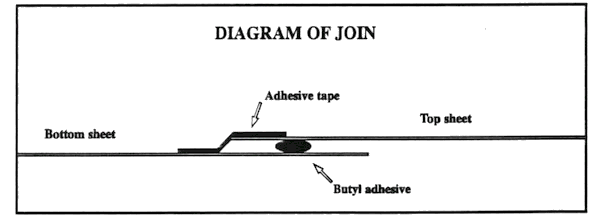
16 At each junction, fold back the upper sheet to reveal the edge of the lower sheet.
17 Unroll a strip of butyl adhesive ** on the lower sheet 10 centimetres in from the edge, remove its paper backing and press the upper sheet down on the adhesive and firm it thoroughly.
18 Apply 75 mm adhesive tape** over the edge of the upper sheet to stick it down to the lower sheet (see diagram).
19 Carefully cover the entire liner with 30 centimetres of the reserved stone-free soil, or pebbles using wheelbarrows and nail-free planks placed on top of the soil, not directly on the liner. Level this by hand, taking care to avoid damaging the liner.
20 Obtain approval of site ecologist for soil levels and liner edge burial.
21 Fill with water to a defined level.
22 Check for leaks by measuring the amount of water added to maintain level in comparison with evaporation figures from nearest meteorological station.
23 When planting into the pond soil, take care (using hand trowels not spades) not to damage the liner.
* Pond liners are ideally butyl rubber sheet, but this is very expensive. Heavy duty polyethylene reservoir liner (0.5 mm thick) is a less expensive substitute. This is obtainable from Visqueen. Yarn Road, Stockton-on-Tees, Cleveland TS 18 3RD. Telephone (0642) 672288. Fax (0642) 677599.
** Butyl adhesive and Tape 1408 (75 mm) are both obtainable from Gawler Plastics, telephone (0454) 324265 or fax (0454)315158.